
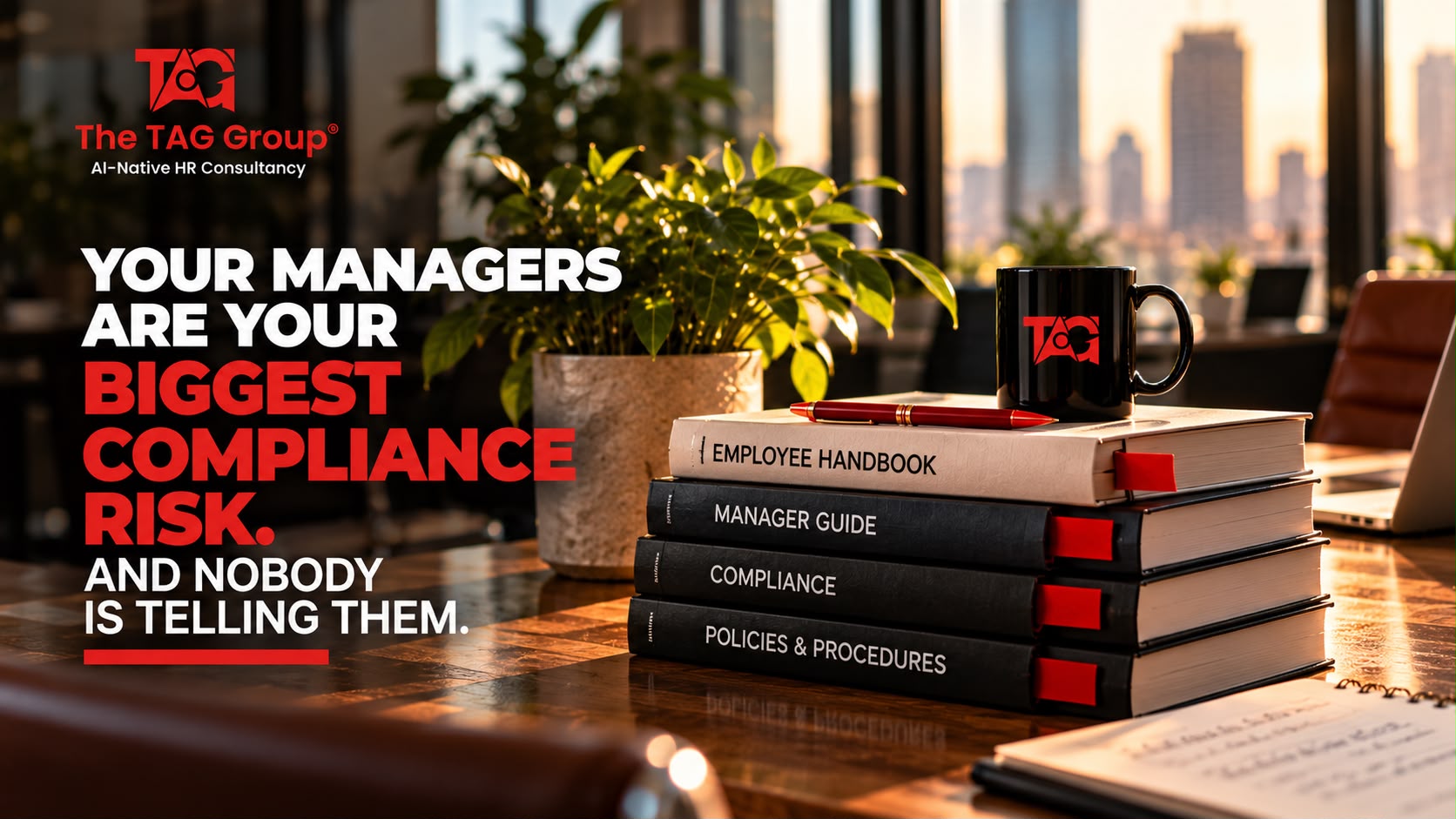
Every company we work with has a compliance program. Policies. Handbooks. Annual harassment training. A hotline number posted in the breakroom.
And every company we work with is quietly carrying legal exposure their managers created without knowing it.
The truth most CHROs will only say behind closed doors is this. Most of the compliance risk in a growing company does not come from bad policies. It comes from good managers making decisions they were never trained to make. A performance conversation that references the wrong protected category. A hiring rubric that quietly filters for something that would not survive a deposition. A promotion decision that pattern-matches instead of documenting. A termination handled in a Slack message.
None of it looks like a lawsuit at the time. All of it looks like a lawsuit twelve months later.
Why this keeps happening
Companies invest in the policies because policies are easy to buy. You retain a firm, you get the handbook, you check the box. Manager judgment is harder to buy because it does not come in a package. It is built through coaching, calibration, and the kind of direct feedback most companies stop giving their managers the moment they get promoted.
So the compliance program sits in one place. The actual risk sits somewhere else. And the people who could close the gap have never been given the tools to do it.
We have watched this pattern play out at companies from twenty employees to two thousand. The manager doing the most damage is almost never the one you would guess. They are usually well-liked, high-performing, and considered a company asset. They are also making three or four judgment calls a week that could unwind a decade of careful policy work.
Most of the compliance risk in a growing company does not come from bad policies. It comes from good managers making decisions they were never trained to make.
What actually protects a company
Real protection is not a policy someone signed. It is a manager who knows what to do when an employee flags a concern in a one-on-one. It is a hiring rubric that documents why the candidate was chosen and why the other qualified candidates were not. It is a performance improvement conversation that separates the observable behavior from the interpretation. It is a termination process that is defensible because it was documented in real time, not reconstructed later.
All of that lives inside your managers. Which means the compliance investment that actually reduces risk is the one you make in manager capability. Not in another policy document.
The uncomfortable version
If you asked us to name the single highest-leverage People investment for a growing company right now, it would not be an AI tool, a new HRIS, or a compliance audit. It would be a real manager development program that treats your middle layer as the compliance surface it actually is.
The companies that get this right in the next twenty-four months will be the ones spending materially less on employment litigation in 2028. The ones who do not will be the ones telling their board that this exposure came out of nowhere.
It did not come out of nowhere. It came from a manager layer that was never given the tools to protect itself.