
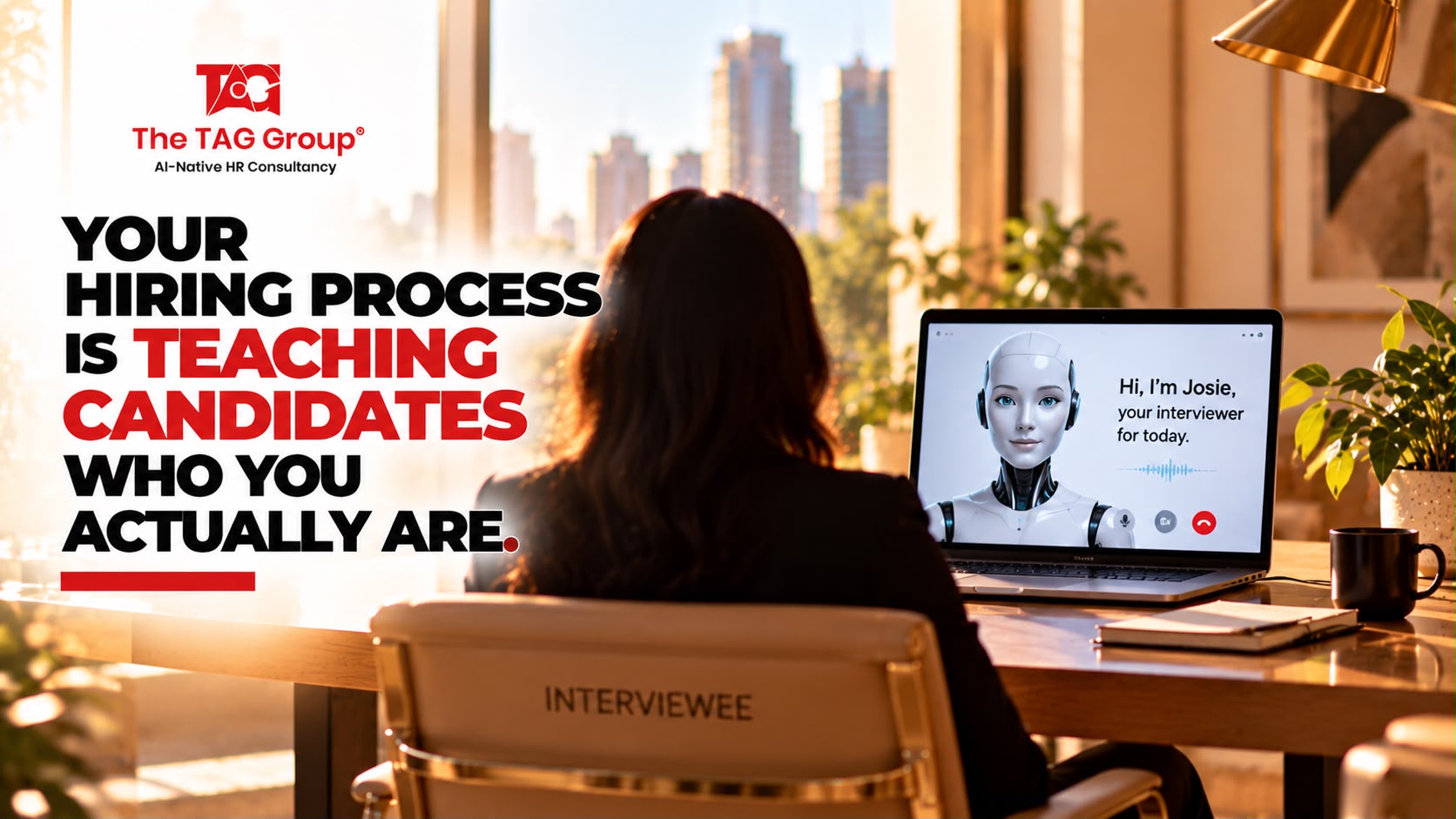
The candidate you want to hire is watching your hiring process for signal about your company.
They noticed the six-week gap between your first email and the actual interview. They noticed the fifth-round interview that repeated the same questions from the third round. They noticed the recruiter who did not know what team they would be joining. They noticed that nobody sent them the salary range even though the law now requires you to. They noticed the two weeks of silence after the final interview when they had cleared their calendar for a decision.
Every step in that process is teaching them something about how your company operates when it matters.
By the time you send them an offer, they have already decided whether to take it.
What the process actually reveals
The length of your interview loop tells them whether your company can make decisions. If it takes eight weeks to hire one person, it takes eight weeks to make every decision at the company. That is a signal.
The consistency across interviewers tells them whether your leadership team is aligned. If four interviewers ask about different things and none of them share notes, that is what internal collaboration looks like at your company on a normal day. Also a signal.
The quality of the questions tells them how you actually evaluate performance. If every interviewer asks generic behavioral questions with no clear connection to the role, the candidate concludes that your performance management is probably just as vague once they are inside.
The way you handle the salary conversation tells them whether they can trust your compensation practices. If they had to volunteer their number three times and you never volunteered your range even though they asked directly, the candidate has already learned that pay conversations at your company are one-directional.
The way you handle rejection tells them whether you handle difficult conversations well in general. If they get ghosted, they are telling six friends about it within a week. Those six friends are your future candidate pool.
Your hiring process is not a filter for finding the right candidates. It is a broadcast of who you actually are as a company.
The candidates you cannot afford to lose
The stronger the candidate, the more they are treating your hiring process as a diagnostic. They have options. They are not just evaluating whether they want the job. They are evaluating whether your company is worth their next three years.
The candidates who fill in every gap with an assumption that things will be fine once they are hired are the candidates who have fewer options. Which is exactly not the candidate you are trying to attract.
So the hiring process that seems tolerable to your internal team is often the hiring process that is filtering out the exact people you want.
What actually good hiring looks like
The candidate hears back within two business days of applying. The recruiter can name the team, the manager, and the specific problem this hire is supposed to solve. The interview loop is designed. Four interviews, each with a specific charter, no repetition, and calibrated interviewers who share notes. The salary range is on the job posting and the hiring manager will actually talk about it. The final decision is communicated within one week. Rejected candidates receive a real, personal note explaining the decision, even if brief.
None of this is expensive. All of it is the product of a designed process rather than a defaulted one.
Companies with great hiring practices are not spending more money. They are spending more attention. And they are teaching every candidate who goes through their pipeline that this is a company that handles the details well.
That signal compounds. The candidates who accept your offer walk in with a completely different mental model of the company. The candidates who did not accept still tell their friends about the great experience. The employer brand builds itself from the inside out.
The version worth internalizing
Your hiring process is not a filter for finding the right candidates. It is a broadcast of who you actually are as a company. Every candidate who goes through it either becomes an employee or becomes a story. Both versions are shaping the market’s perception of your company right now.
Design it accordingly.